
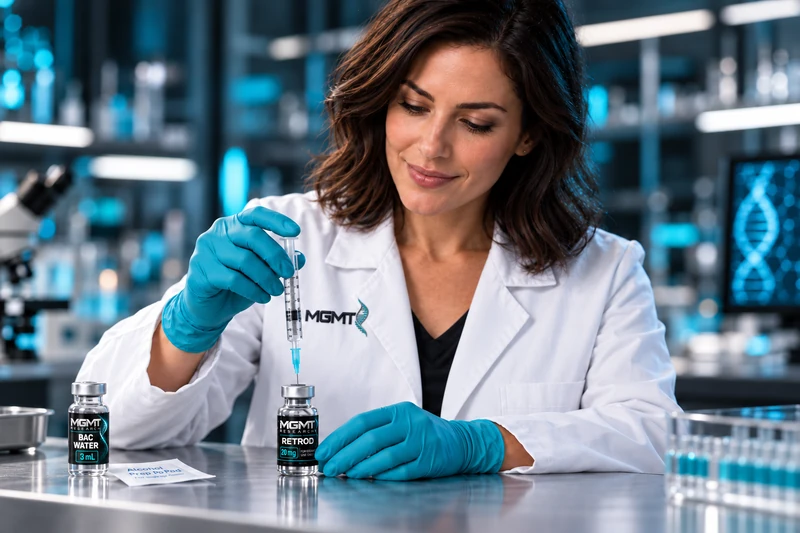
What does reconstituting mean?
Reconstitution means adding a specified liquid to a dry preparation to make a solution. Lyophilized means freeze-dried: the material has been dried before it reaches your laboratory.
The important variables are the amount of material in the vial, the compatible diluent, and the final solution volume. These determine concentration. Adding more liquid changes concentration; it does not add more peptide.
Check the identity, strength, lot, storage label, and preparation documentation. RETROD, TIREZ, TESAROSSA, and CU-TACH are different compounds; compatibility and stability should be confirmed for each one.
What you’ll need
- Your research vialConfirm the compound, quantity, and lot before opening.
- A compatible diluentBacteriostatic Water is an option only when the preparation instructions specify it.
- Alcohol prep padsFor cleaning vial stoppers as directed by your laboratory procedure.
- Reconstitution syringeUse new sterile equipment with suitable volume markings and a compatible needle.
- Sharps containerKeep an approved disposal container within reach.
- Labels and a preparation recordRecord the diluent, concentration, preparation date, and assigned discard date.
Work on a clean, uncluttered surface with good lighting. Review the complete procedure before handling the vial.
Laboratory preparation checks
Confirm the preparation plan
Read the product documentation and laboratory procedure. Establish the compatible solvent, intended concentration, required volume, and storage conditions. Do not assume every vial can accept the same volume.
Check your materials
Inspect packaging, seals, expiry dates, and the vial for damage. Use a fresh sterile syringe and needle for every vial entry. [1] Set up your labels and sharps container before starting.
Prepare the vial stoppers
Perform hand hygiene and use the protective equipment required by your laboratory. Remove the protective flip caps, clean the rubber stoppers, and allow the antiseptic to dry fully. Keep cleaned surfaces untouched.
Measure the specified diluent
Measure the volume established by the preparation instructions. Check the syringe scale at eye level and confirm whether its markings represent millilitres or U-100 volume units.
Transfer with control
Introduce the diluent at the rate and by the method specified for that compound. The method must be suitable for the actual container and material; this overview does not validate a transfer procedure.
Mix as directed
Follow the compound-specific mixing method. When gentle swirling is specified, avoid vigorous agitation. Do not add heat, change solvents, or keep adding liquid to troubleshoot without checking the preparation instructions.
Inspect and document
Compare the solution with its expected appearance. Unexpected cloudiness, colour changes, or persistent particles need investigation; visual clarity alone does not establish sterility or potency.
Label, dispose, and store
Label the vial with the concentration, diluent, preparation date, and validated discard date. Place used sharps directly in the sharps container without recapping. Store according to the product documentation and laboratory procedure.
A few things to know
How much water should I add?
Use the volume established for your compound and target concentration. A vial’s nominal capacity is not a universal fill recommendation. Check both the preparation instructions and available working volume.
Is bacteriostatic water the same as sterile water?
No. Bacteriostatic water contains a preservative; sterile water for injection does not. Neither is automatically the correct solvent for every compound. Follow the specified diluent and the container’s handling instructions. [2]
Can I substitute saline?
Only when the compound’s preparation documentation supports it. Salts, preservatives, and pH can affect compatibility. Do not treat saline, bacteriostatic water, and plain sterile water as interchangeable.
How long will a mixed vial last?
There is no single shelf life for all reconstituted peptides. Chemical stability and microbiological safety are separate questions. Use a validated preparation-specific storage period; a preservative or a clear appearance does not establish one. [1] [2]
Should I refrigerate or freeze it?
Follow the label and validated storage instructions for that preparation. Do not assume that freezing extends stability or that every compound tolerates freeze–thaw cycles.
What if powder or particles remain?
Pause and check the expected appearance, solvent, concentration, and mixing instructions. Do not improvise by heating or changing the formula. Contact orders@mgmtresearch.com for product documentation.
Do syringe units mean milligrams?
No. On a U-100 syringe, 100 marked units correspond to 1 mL. The mass in that volume depends on the solution concentration. These volume markings should not be confused with a compound’s biological International Units (IU).
Concentration made simple
Keep mass and volume separate. Milligrams (mg) describe the amount of material; millilitres (mL) describe the volume of solution.
A laboratory calculation example
A preparation containing 10 mg in a final solution volume of 2 mL has a concentration of 5 mg/mL. A 0.5 mg analytical sample would occupy 0.10 mL, corresponding to the 10-unit mark on a U-100 syringe. Check the actual scale and its smallest graduation. [3]
| Material | Final volume | Concentration |
|---|---|---|
| 10 mg | 2 mL | 5 mg/mL |
| 20 mg | 2 mL | 10 mg/mL |
Arithmetic examples only. These are not solvent recommendations, preparation recipes, or administration instructions. Use the final volume specified by the validated method. Label-based arithmetic does not account for purity, recovery or transfer losses; analytical work may require a measured concentration.
Let the calculator check the arithmetic.
Enter the vial quantity, solution volume, and sample amount in the MGMT Research calculator. Confirm the inputs and units against your laboratory record before using the result.
Open reconstitution calculator →Handling references
These sources cover healthcare handling, a named manufacturer’s diluent and measurement errors. They do not validate an MGMT Research material or its preparation.