Vial volume
3 mLOne vial of BAC Water

RESEARCH USE ONLY · CANADA 19+ · UNITED STATES 21+
Under MGMT Research store policy, visitors in Canada must be at least 19 years old and visitors in the United States must be at least 21 years old. By entering, you confirm that you meet the minimum age for your country.
Every compound shown is presented strictly for controlled laboratory and analytical research—not for human or veterinary use.
Research and analytical use only
Not for human or veterinary use
Responsible handling required
You must be 19+ in Canada or 21+ in the United States to enter MGMT Research.
MGMT RESEARCH
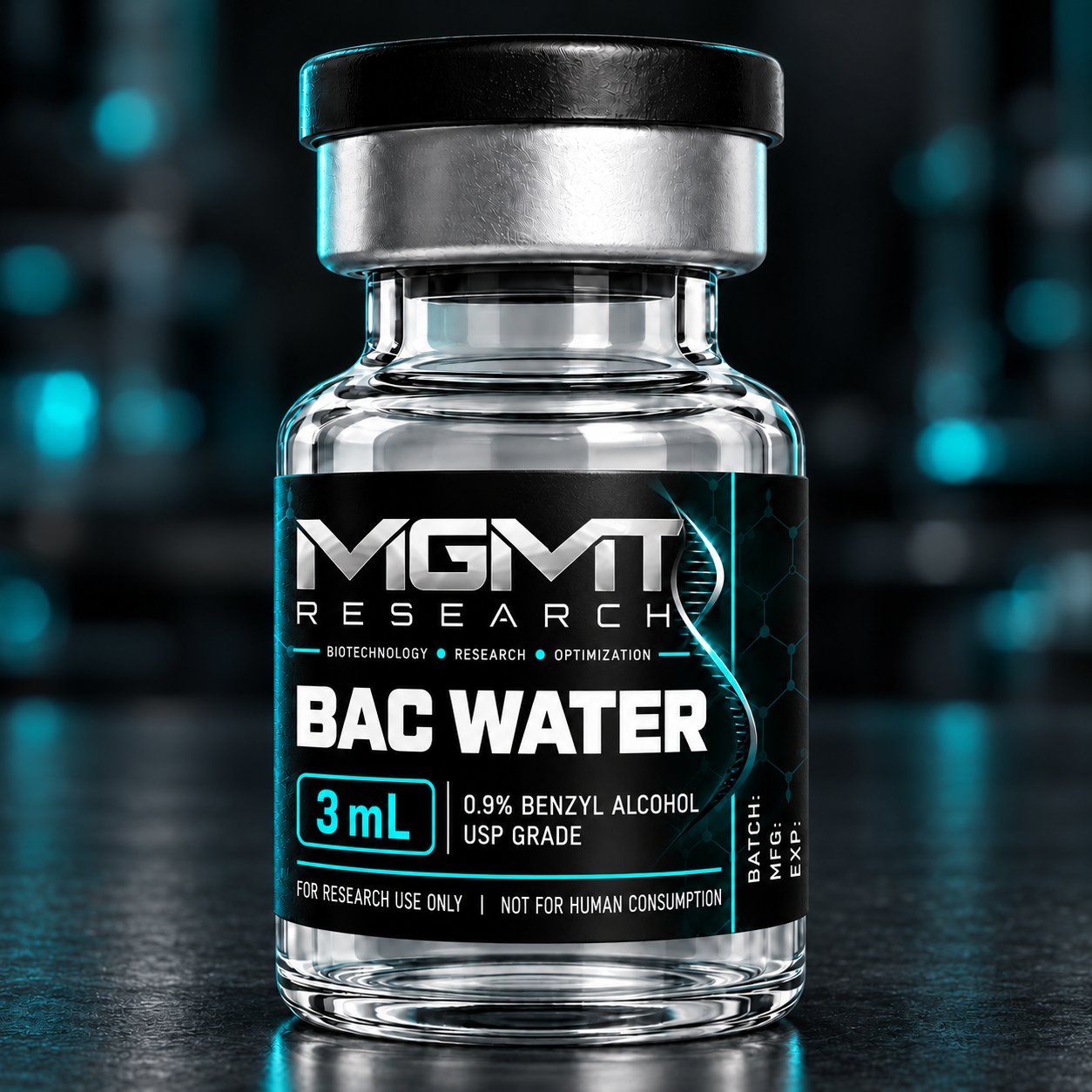
Bacteriostatic Water · Research diluent
A 3 mL diluent for compatible laboratory reconstitution and dilution protocols. Bacteriostatic water contains a preservative to inhibit bacterial growth; the required diluent and volume depend on the compound and protocol.
Every compound vial includes one free 3 mL Bacteriostatic Water and one compound / BAC pair holder. Any strength. No minimum purchase. Bundles count their included BAC Water toward this offer.
Tax-inclusive CAD pricing. E-transfer accepted · Credit cards coming soon.
Mix Easy · Open the calculator ↗One vial of BAC Water
Ready as a research diluent
Compatible preparation protocols
Check your supplied product label
No universal reconstitution volume
Compatible non-human protocols
The 3 mL label states the volume supplied. It does not mean that every research vial requires 3 mL of diluent.
Bacteriostatic water is water formulated with a preservative, commonly benzyl alcohol, to inhibit bacterial growth. It differs from preservative-free sterile water. Refer to the supplied product label for its exact formulation, preservative concentration, expiry, and storage instructions.
It serves as a diluent or solvent to dissolve a compatible dry material or dilute an existing solution. In laboratory peptide research, reconstitution means adding an appropriate diluent to lyophilized powder to prepare a solution for a specified procedure.
Each MGMT Research vial contains 3 mL and is sold separately for $10 CAD. BAC Water is also included through our qualifying compound-vial promotion and selected bundles.
Follow the storage instructions and expiry printed on your supplied vial. Orders received before 12 PM EST ship the same business day.
Select the compound you are preparing, its vial amount, the volume of diluent added, and your laboratory sample amount. The calculator converts those inputs into concentration, volume, and U-100 markings.
Enter an example amount to calculate its volume.
0.2 mL of solution per sample
2 mg ÷ 10 mg/mL = 0.2 mL
Concentration = vial amount ÷ solution volume. Sample volume = sample amount ÷ concentration. U-100 scale units = volume in mL × 100; these are volume markings, not units of compound potency.
This example assumes the final solution volume equals the diluent volume entered, and that the compound dissolves completely. It does not establish solubility, compatibility, stability, or an administration dose.
Decimal measurements are mathematical results and may fall between markings. Full samples are rounded down; they do not account for handling losses.
The calculator checks concentration mathematics. It does not select a treatment dose or establish compatibility, sterility, or stability. SEMARO is temporarily unavailable and is omitted from this selector. BAC Water is the diluent, not a peptide.
BAC Water is not suitable for every compound. Preservative-containing and preservative-free water are different preparations; the appropriate choice depends on the material and documented procedure.
A preservative inhibits bacterial growth but does not sterilize a contaminated preparation or replace appropriate handling technique.
The appropriate volume of BAC Water depends on the compound, required concentration, and validated research procedure. The 3 mL vial size is the volume supplied, not a universal mixing instruction.
Compound amount ÷ final solution volume = concentration. Laboratory sample amount ÷ concentration = sample volume.
Follow the documented diluent, equipment, mixing method, and storage requirements for the material being prepared. Mix Easy assumes the entered diluent volume equals the final solution volume.
Open Mix Easy ↗Read reconstitution basics ↗